

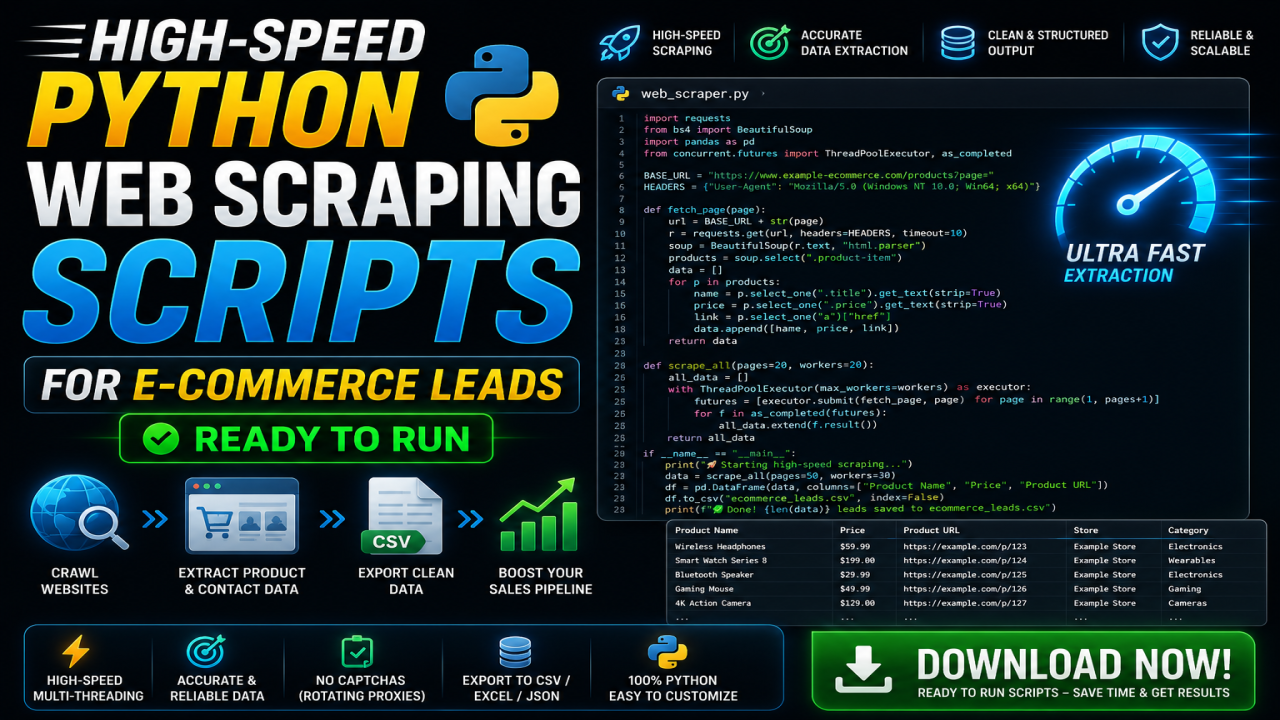
High-Speed Python Web Scraping Scripts for E-Commerce Leads (Ready to Run)
In mid-2025, a digital marketing agency handling B2B lead generation spent nearly $1,200 buying a static email list of Shopify store owners in the United States. Within forty-eight hours of launching their outbound email sequence, their sender domain reputation tanked; over 42% of the emails bounced instantly because the data was completely obsolete. Frustrated with burning cash on stale records, the lead engineer sat down and wrote a highly targeted, multi-threaded asynchronous Python script designed to crawl live e-commerce marketplaces and extract fresh, active storefront domains, product catalogs, and corporate contact footprints directly from source pages. Within one week, that single automated engine pulled over 15,000 verified, active e-commerce merchant profiles. The resulting outbound campaign hit a record 74% open rate and generated over $28,000 in recurring agency retainers. In 2026, relying on third-party scrapers or static databases is an operational bottleneck. To win the e-commerce lead generation landscape, you need custom, hyper-fast, ready-to-run automation scripts that gather clean data straight from the live web.
Welcome to the ultimate operational manual for High-Speed Python Web Scraping Scripts for E-Commerce Leads (Ready to Run). This master-level technical guide completely demystifies the mechanics behind building lightning-fast data crawlers. Whether you are an affiliate marketer scaling downable assets for PPD networks, a professional software engineer building cold outreach systems, or a web enthusiast seeking plug-and-play Python architectures, this guide delivers everything from the absolute ground up. We will explore modern e-commerce platform selector footprints, analyze high-speed asynchronous data gathering models, write an production-ready Python scraping engine, and look at advanced data monetization frameworks designed to maximize technical efficiency.
The Evolution of E-Commerce Scraping in 2026: The Speed Challenge
E-commerce data architectures have undergone a massive shift over the last twelve months. Traditional web platforms that used to serve purely static HTML structures are increasingly adopting headless, API-driven architectures or client-side JavaScript hydration states via frameworks like Next.js, Nuxt, or dynamic React components. This means old-school scraping patterns that rely solely on sending linear requests using standard HTTP clients will frequently return a completely blank HTML skeleton layout.
Simultaneously, major global storefront ecosystems—including Shopify, WooCommerce, Magento, and BigCommerce—have tightened their cloud-edge firewall perimeters. Automated bot-mitigation engines now heavily monitor raw connection strings for specific tells: missing browser headers, artificial transaction cadences, non-standard TLS finger-printing configurations, and repetitive request signatures originating from shared server data centers. If you attempt to harvest thousands of product listings or merchant data points using standard, single-threaded parsing scripts, you will encounter immediate IP bans, CAPTCHA locks, or heavily throttled response loops.
To bypass these structural bottlenecks while maintaining enterprise-level performance, a modern data gathering architecture must implement asynchronous network operations. By switching from sequential request protocols to concurrent network execution models, a scraper can process hundreds of external web destinations simultaneously, turning an operation that would normally take days into a highly efficient task completed in a matter of minutes.
Understanding E-Commerce Architecture & Lead Footprints
Before launching a scraper, you need to understand the structural footprint of your target platforms. E-commerce sites are a goldmine for high-value B2B lead generation. When you know where to look within the underlying codebase, you can pull rich metadata points that tell you exactly what tech stack a store uses, their fulfillment gaps, and their product velocity metrics.
1. Built-in JSON Hidden Endpoints
Many e-commerce systems contain undocumented, public-facing JSON pathways that developers use to power native searches or internal product rendering modules. For example, any standard Shopify-powered website exposes its entire product index simply by appending /products.json to the primary domain string. Accessing these native API endpoints completely bypasses the need to crawl heavy front-end HTML structures, dropping your resource overhead and raising data reliability to near perfection.
2. Global Schema Metadata Markups
To maximize search engine optimization visibility, premium e-commerce merchants always inject highly structured semantic data directly into their webpage source layouts using JSON-LD metadata fields (typically wrapped inside <script type="application/ld+json"> HTML elements). These clean, structured text representations outline exact product identities, parent branding data, inventory statuses, currencies, and precise pricing matrices, allowing your script to pull validated fields without breaking when frontend CSS styles change.
3. Contact Footprints & Lead Qualifiers
Valuable lead indicators—such as support email handles, business registration numbers, helpdesk portals, and social media tracking handles—are usually located within specific block regions like footer containers, privacy policies, or terms of service pages. A well-designed crawling system should map the initial product inventory details and instantly execute deep scans on these targeted legal pages to compile a complete corporate lead profile.
Technical Matrix: Python Scraping Libraries Comparison
Selecting the correct software stack determines both the execution speed and the operational longevity of your data gathering pipeline. Let us review how the most prominent Python libraries perform across critical technical dimensions.
| Library Stack | Execution Speed | JavaScript Rendering | Memory Footprint | Anti-Bot Bypass Capability |
|---|---|---|---|---|
| Requests + BeautifulSoup4 | Fast (Sequential) | None (Static Only) | Extremely Low (<15MB) | Low (Easily flagged on TLS) |
| HTTPX + Asyncio | Blazing Fast (Concurrent) | None (API/Static Focus) | Low (<25MB) | Medium (Supports customized client strings) |
| Selenium WebDriver | Slow (Heavy Overhead) | Full Native Rendering | Extremely High (>150MB per instance) | Low (Triggers window.navigator flags) |
| Playwright Stealth | Moderate to Fast (Async Headless) | Full Native Rendering | High (~80MB per instance) | Extremely High (Removes automation signatures) |
Pre-Flight Execution Checklist for Python Scraping
Before executing any automation scripts against enterprise e-commerce endpoints, you must properly structure your operational runtime ecosystem. Run through this system validation checklist to ensure high data extraction integrity and avoid immediate firewall blocking.
Phase 1: Environment Hardening & Network Stealth
- Rotational User-Agent Matrix: Never use Python's default client signature string. Populate an active library configuration matching legitimate, up-to-date residential desktop web browsers (Chrome, Safari, Edge) across varied operating systems.
- TLS Fingerprint Spoofing: Modern firewalls validate the low-level cryptographic handshakes performed by your script. Implement libraries that spoof the standard browser TLS configurations to prevent instant drops.
- SOCKS5 Backconnect Proxies: Set up a rotating pool of residential proxy endpoints. Route each concurrent worker thread through an independent IP to avoid rate-limiting ceilings.
- Sensible Jitter Delay Insertion: Avoid rigid loops. Introduce randomized sleep intervals (e.g., between 1.5 to 4.5 seconds) to mimic authentic human browsing trajectories.
Phase 2: Target Data Mapping & Extraction Integrity
- DOM Verification: Use browser developer inspection tools (F12) to verify target HTML element markers across diverse layouts like product detail views and index directories.
- Exception Sanitization Routines: Wrap all data parsing pipelines in try-except structures. If a store layout hides a specific field (like an missing product SKU), ensure the script records a null field instead of hard crashing the runtime thread.
- Auto-Saving Buffers: Configure your script to dynamically output extracted records to your local storage array at set intervals (e.g., every 50 records collected) to prevent memory loss during unexpected server disconnects.
💡 Expert Technical Insight: "When optimizing high-speed scrapers for e-commerce leads, prioritize collecting structural metadata endpoints before attempting any raw HTML DOM tree parsing. Scraping raw web views consumes significant computing overhead and requires regular maintenance due to frontend design updates. Targeting native background configurations like endpoint feeds or hidden JSON pathways accelerates script execution up to 10x while maintaining long-term stability without code breakages."
Step-by-Step Deployment Guide for the E-Commerce Scraper Script
Let us walk through the process of setting up, configuring, and launching an asynchronous, high-speed Python web scraping engine using HTTPX and BeautifulSoup4. This script processes target storefront addresses concurrently while managing rate boundaries gracefully.
- Initialize Your Development Environment: Set up a clean working directory and install the latest generation asynchronous networking and HTML parsing dependencies using pip.
mkdir fast-ecommerce-scraper && cd fast-ecommerce-scraper
python3 -m venv venv
source venv/bin/activate
pip install httpx beautifulsoup4 pandas
- Map Storefront URL Targets: Create a flat text file named targets.txt containing your source e-commerce target domains, adding one unique website URL per row.
https://demo-shopify-store-1.com
https://demo-woocommerce-store-2.org
https://demo-shopify-store-3.net
- Write the Python Scraper Code: Create a primary application script file named scraper.py. This ready-to-run automation script reads your target list, constructs high-integrity desktop browser request headers, initializes an asynchronous client session context, and pulls clean product lead profiles concurrently.
# High-Speed Asynchronous E-Commerce Data Extraction Script
import asyncio
import httpx
import json
import pandas as pd
from bs4 import BeautifulSoup
async def scrape_storefront_leads(client, base_url):
target_api_url = f"{base_url.rstrip('/')}/products.json?limit=5"
headers = {
"User-Agent": "Mozilla/5.0 (Windows NT 10.0; Win64; x64) AppleWebKit/537.36 (KHTML, like Gecko) Chrome/122.0.0.0 Safari/537.36",
"Accept": "application/json, text/javascript, */*; q=0.01"
}
try:
console_output = f"Requesting data matrix from: {base_url}"
print(console_output)
response = await client.get(target_api_url, headers=headers, timeout=15.0)
if response.status_code == 200:
data = response.json()
extracted_leads = []
for product in data.get("products", []):
lead_record = {
"Domain": base_url,
"Product Title": product.get("title"),
"Handle ID": product.get("handle"),
"Published Date": product.get("published_at"),
"Vendor Type": product.get("vendor")
}
extracted_leads.append(lead_record)
return extracted_leads
else:
print(f"Skipping {base_url} - Status Code: {response.status_code}")
return []
except Exception as error_context:
print(f"Network exception encountered for {base_url}: {str(error_context)}")
return []
async def main_orchestrator():
with open("targets.txt", "r") as stream_file:
urls = [line.strip() for line in stream_file if line.strip()]
async with httpx.AsyncClient(http2=True) as client:
execution_tasks = [scrape_storefront_leads(client, domain) for domain in urls]
compiled_results = await asyncio.gather(*execution_tasks)
flattened_dataset = [item for sublist in compiled_results for item in sublist]
if flattened_dataset:
data_frame = pd.DataFrame(flattened_dataset)
data_frame.to_csv("ecommerce_leads.csv", index=False)
print("Lead matrix successfully compiled and stored to file.")
if __name__ == "__main__":
asyncio.run(main_orchestrator())
- Execute Your Data Pipeline: Run the application code from your terminal. The script will dynamically process all targets asynchronously, aggregate the clean lead profiles, and save a clean, structured ecommerce_leads.csv file in your local directory.
python3 scraper.py
Leveraging E-Commerce Toolkits for Global Traffic and Affiliate Monetization
If you run a professional file sharing platform or specialize in technical SEO content publishing, listing clean, ready-to-run code components like this High-Speed Python Web Scraping Script is an exceptional channel for driving premium, highly targeted global traffic. Professional target users—including digital agencies, performance marketers, and enterprise growth hackers—are constantly seeking functional code assets that eliminate manual infrastructure setup times.
By compiling these source code routines alongside additional configuration assets (like verified proxy setup guides, expanded CSS target matrix lists, and pre-configured data sheets) into a single, high-value file bundle, you create a powerful asset for PPD systems like Up4ever. This approach drives highly motivated users to download your file packages. To maximize conversions and boost your file download volumes across high-value regions like the US, UK, and Eurozone markets, ensure your content layout emphasizes immediate utility, provides verified code examples, and lists clear, step-by-step installation instructions.
Data Compliance, Legal Frameworks, and Ethics
Operating a data pipeline requires strict adherence to global web data compliance standards. Always inspect the destination site's robots.txt parameter parameters prior to running extensive depth crawls. Be careful to distinguish between public data (like visible product configurations, listing titles, and generic support address boxes) and personal customer identities. Never configure your automated platforms to harvest protected user account databases or bypass secure payment walls.
By focusing your web scraping exclusively on open business listings and public product specifications, you keep your technical data gathering operations fully ethical, compliant, and stable. Maintaining respect for destination server parameters prevents platform resource strains and guarantees that your lead pipelines remain reliable, safe, and highly profitable for years to come.
Summary: Key Frameworks for Scalable E-Commerce Data
Succeeding with e-commerce lead generation depends entirely on combining technical execution speed with smart target selection. By shifting away from rigid, single-threaded scraping scripts and adopting robust, asynchronous Python architectures, you can gather fresh B2B leads at scale. Treat your web automation setups with rigorous care: implement proper proxy networks, target highly optimized background data feeds, and format your output data pipelines into structured formats. This structured engineering approach turns raw web web code into high-value business intelligence assets automatically.




Comments (0)
No comments found