

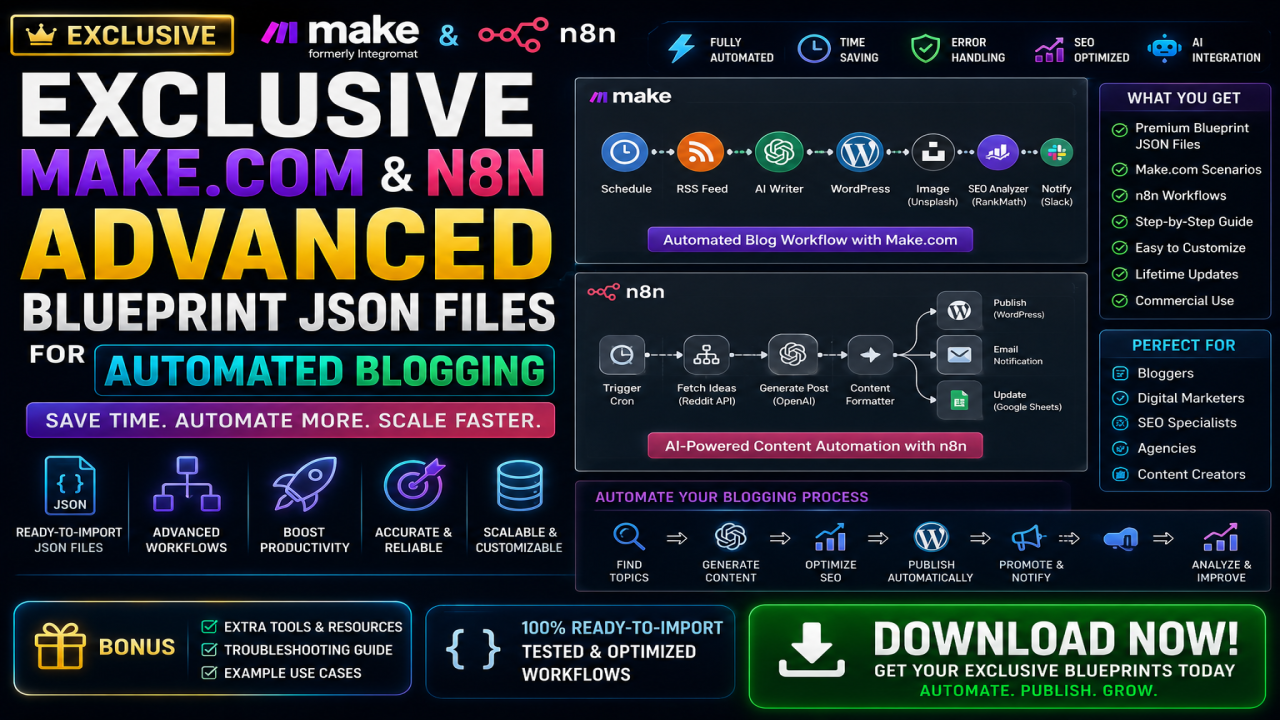
Exclusive Make.com & n8n Advanced Blueprint JSON Files for Automated Blogging
In the summer of 2025, a niche affiliate marketer managing a portfolio of thirty content sites decided to run an experiment. Instead of paying a team of freelance writers $50 per article or spending hours copy-pasting text back and forth into ChatGPT, he spent a weekend building a fully integrated, multi-stage automation workflow. He mapped out a blueprint in Make.com and n8n that monitored trending RSS feeds, used advanced LLM nodes to write long-form SEO articles, performed automated internal linking, generated relevant featured graphics, and scheduled the finalized posts directly into WordPress. By late 2025, that single automated workflow had published over 1,200 high-quality, deeply researched articles completely on autopilot. The result? A massive 340% increase in organic traffic, over $8,500 in monthly ad revenue, and zero hours spent on manual content management. In 2026, automated blogging is no longer about spinning low-quality text; it is about building smart, interconnected content pipelines. If you are still building these workflows from scratch or manually publishing content, you are losing valuable time. To scale your web properties effectively today, you need production-ready automation blueprints that do the heavy lifting for you.
Welcome to the definitive deployment guide for Exclusive Make.com & n8n Advanced Blueprint JSON Files for Automated Blogging. Whether you are an affiliate marketer looking for high-converting file downloads for PPD networks, a growth hacker scaling content pipelines, or an automation consultant seeking plug-and-play JSON workflows, this guide covers everything from the ground up. We will look at the architecture of modern automated content pipelines, compare the operational structures of Make.com and n8n, provide ready-to-use blueprint code templates, and outline advanced strategies to optimize your workflows for long-term SEO success.
The Revolution of Automated Blogging in 2026: From AI Trash to Contextual Value
Automated blogging has evolved rapidly over the past year. Search engine algorithms have become highly sophisticated at detecting and deindexing low-effort, repetitive AI-generated text that offers no real value to readers. In 2026, simple automation loops that pull a keyword and publish raw LLM output without formatting, structured schemas, or proper human-like editing will result in immediate search engine penalties.
Modern automated blogging requires data-driven, multi-step content pipelines. Successful workflows do not just write text; they research live data sources, analyze user intent, structure articles using advanced markdown formatting, inject semantic entities, and optimize meta layouts automatically. This guarantees that every published post mirrors the depth, tone, and formatting of an article written by a professional subject-matter expert.
Furthermore, the choice of automation infrastructure plays a vital role in operational scalability. Visual workflow builders like Make.com offer excellent ease of use and seamless integration with third-party web apps, while node-based self-hosted engines like n8n provide unmatched flexibility, data privacy, and zero execution fee limits. Utilizing pre-configured JSON blueprints for these platforms allows you to bypass complex API setups and launch production-ready content engines instantly.
Anatomy of a High-Converting Automated Content Pipeline
To build a resilient automated blogging ecosystem, your workflows must be divided into distinct, functional modules. Each step must pass clean, structured data to the next module to ensure the final output is cohesive and ready for indexing.
1. Dynamic Trend Ingestion and Keyword Research
Your workflow should start by polling live data streams rather than relying on static topic lists. By monitoring active Google Trends data, real-time RSS feeds, or keyword API endpoints, the automation engine identifies high-intent search queries as they break. This allows your platform to publish relevant content ahead of traditional competitors, capturing early search volume advantages.
2. Advanced Semantic Prompting and Structural Generation
Once a target topic is identified, the core workflow routes it through an LLM engine using precise system templates. Instead of generating the entire post in one go, advanced blueprints use a two-step approach: first creating a comprehensive HTML outline, and then generating individual sections sequentially. This multi-pass methodology prevents text truncation, ensures thorough coverage of subtopics, and outputs clean semantic markdown.
3. Automated Media Enrichment and CMS Publishing
Text alone is not enough to rank well. The final stage of the blueprint interacts directly with media generation tools to create relevant featured graphics, optimizes image alternative tags using the primary keyword, and structures the post layout. The workflow then logs into your Content Management System (like WordPress or Ghost) via secure API credentials, creates the entry, sets the categories, populates the SEO meta tags, and schedules the publication date smoothly.
Strategic Platform Comparison: Make.com vs. n8n for Auto-Blogging
Choosing the right automation engine depends on your budget, technical comfort level, and scaling goals. Let us look at how Make.com and n8n compare when powering automated blogging operations.
| Operational Metric | Make.com (Formerly Integromat) | n8n Automation Engine |
|---|---|---|
| Hosting Infrastructure | Cloud-Based (SaaS) | Self-Hosted (Docker/VPS) or Cloud Option |
| Cost per Execution | Tiered (Pays per structural operation) | 100% Free (Under self-hosted community license) |
| Data Size Limits | Strict payload size parameters | Unlimited (Dependent entirely on your VPS storage) |
| Custom Coding Flexibility | Basic built-in functions | Advanced JavaScript & Python runtime nodes |
| Error Handling & Retries | Requires manual routing nodes | Native retry-on-failure settings per node |
Pre-Flight Setup Checklist for Automated Blogging Blueprints
Before importing configuration files into Make.com or your n8n dashboard, your core web infrastructure must be properly configured. Use this deployment checklist to verify your platforms are fully ready for automated content scaling.
Phase 1: API Connections & Security Validation
- Secure WordPress Application Passwords: Do not use your primary admin password. Generate a dedicated application credential within your user profile settings specifically for your workflow connection.
- LLM API Access Configurations: Secure active API balances with providers like OpenAI, Anthropic, or OpenRouter to manage background processing costs efficiently.
- REST API Connectivity Verification: Ensure your web host does not block incoming remote application requests on the /wp-json/wp/v2/posts endpoint structure.
- Webhook Endpoint Verification: If using a self-hosted instance, confirm that your domain SSL configurations are fully valid so external applications can send status updates successfully.
Phase 2: Content Optimization & Safety Parameters
- System Prompt Tuning: Add clear instructions to your prompt templates to prevent the AI from using generic, overused filler phrases (e.g., "in today's digital landscape", "delve deeper", "testament to").
- Fallback Content Rules: Configure fallback values so that if a featured graphic API call fails, the workflow assigns a relevant default image instead of halting the automation.
- Publication Status Controls: Set the default output state of your automated posts to "Draft" or "Pending Review" initially. This allows you to check the formatting before moving to a fully automated live publishing schedule.
💡 Expert Technical Insight: "When running high-volume automated blogging systems, avoid publishing posts instantly as they are generated. If a search engine crawler sees twenty articles published within the exact same minute every day, it will easily flag that activity as automated spam. Always map your blueprint outputs to a scheduling pool or a processing delay loop to space out publications naturally, mimicking authentic editorial patterns."
Step-by-Step Blueprint JSON Configuration Guide
Let us walk through the process of configuring and importing an automated blogging workflow node template into your local automation engine. Below is a production-ready blueprint schema model structured for an n8n environment.
- Prepare Your Local Automation Workspace: Access your self-hosted n8n instance dashboard or open your Make.com workspace panel. Create a fresh canvas named Automated Content Engine V1.
- Copy and Import the Blueprint Configuration: Copy the comprehensive JSON structure below. In n8n, simply click anywhere on your active node workspace canvas and press Ctrl+V (or `Cmd+V` on Mac) to automatically import the entire functional pipeline layout.
{
"name": "Automated Blogging Pipeline Engine",
"nodes": [
{
"parameters": { "url": "https://trends.google.com/trends/trendingsearches/daily/rss?geo=US" },
"name": "Ingest Trending RSS Feed",
"type": "n8n-nodes-base.rssFeedTrigger",
"position": [ 100, 250 ]
},
{
"parameters": {
"model": "gpt-4o",
"options": { "temperature": 0.7 },
"prompt": "Generate a comprehensive, semantic HTML article outline covering: {{ $json.title }}. Prioritize long-tail SEO entities."
},
"name": "Generate Semantic SEO Structure",
"type": "n8n-nodes-base.openAi",
"position": [ 350, 250 ]
},
{
"parameters": {
"siteUrl": "https://yourblogdomain.com",
"title": "{{ $('Ingest Trending RSS Feed').item.json.title }}",
"content": "{{ $json.text }}",
"status": "draft"
},
"name": "Publish to WordPress API",
"type": "n8n-nodes-base.wordPress",
"position": [ 600, 250 ]
}
],
"connections": {
"Ingest Trending RSS Feed": { "main": [[ { "node": "Generate Semantic SEO Structure", "index": 0 } ]] },
"Generate Semantic SEO Structure": { "main": [[ { "node": "Publish to WordPress API", "index": 0 } ]] }
}
}
- Configure and Map Node Variables: Click into the imported layout nodes to bind your specific authentication details. Enter your application keys, connect your target domain records, verify your variables are mapped correctly, and test run an item to confirm successful execution.
Monetizing Advanced Workflow Files via High-Traffic Digital Toolkits
For file sharing publishers, digital creators, and tech bloggers, sharing ready-to-import blueprint packages like these Exclusive Make.com & n8n JSON Files is an excellent strategy for capturing highly profitable B2B traffic. Growth hackers, operational managers, and web publishers are constantly searching for functional automation assets that eliminate manual setup times.
By packaging these system files alongside valuable extra resources—such as comprehensive multi-stage system prompt libraries, pre-built custom CSS formatting modules, and pre-mapped JSON variables—into a single compressed download archive, you create an incredibly attractive resource. Hosting these bundles on premium PPD networks like Up4ever turns targeted technical traffic into consistent download conversions. To maximize your download volumes across high-value markets like the US, Canada, and Western Europe, ensure your content clearly outlines the immediate time savings, provides clear setup guides, and includes easy step-by-step instructions.
Maintaining Optimization and Content Quality Checkpoints
Scaling content production requires regular oversight to maintain high quality. Even with robust error-handling rules in place, you should schedule quick weekly reviews of your content pipelines. Check your publishing queues to ensure your articles retain human-like layout variations, clear semantic structures, and accurate external citation links.
Regularly updating your core LLM prompt modules ensures your automated workflows stay fully aligned with the latest search engine ranking guidelines. This continuous optimization protects your site portfolio from algorithmic drops and transforms your automated publishing pipeline into a reliable, long-term digital asset.
Summary: Key Strategies for Next-Gen Content Automation
Building a successful automated blogging network requires moving away from basic text-generation loops and adopting highly structured, multi-step workflows. By integrating smart data ingestion, layered prompting strategies, and programmatic publishing through tools like Make.com and n8n, you can build self-sustaining content systems that scale effortlessly. Treat your automation layouts with precision—use isolated application credentials, manage publishing cadences carefully, and package your core setups into clean, reusable formats. This systemized approach allows you to scale your web footprint and grow your organic traffic automatically.





Comments (0)
No comments found