

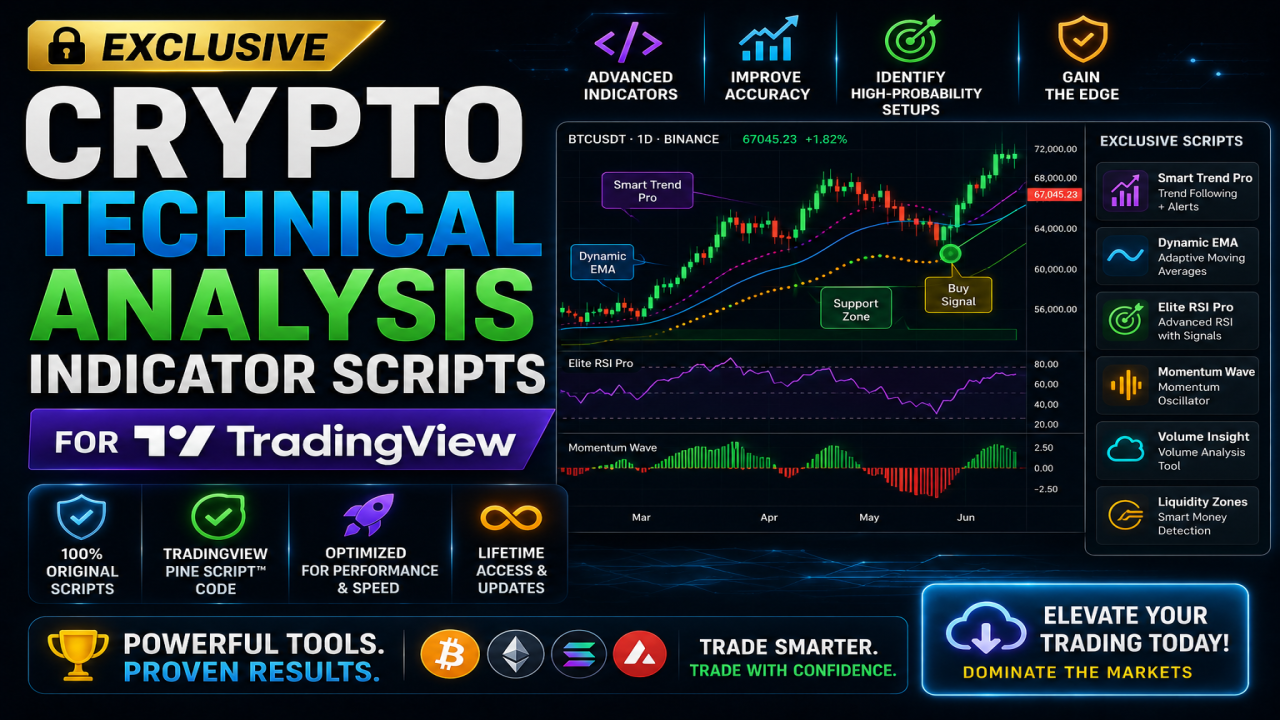
Exclusive Crypto Technical Analysis Indicator Scripts for TradingView
⚠️ Systemic Reality Check: Over 90% of retail traders utilize identical public indicators, effectively feeding the exact same liquidity data to institutional counter-parties. Breaking this loop requires a structural coding intervention.
Every standard technical dashboard is lying to you. When you load a basic chart, you aren't looking at real-time market intent—you are looking at a chronological graveyard of price action. By the time a default retail oscillator flashes a confirmation, the underlying capital flows have already shifted, transforming your entry into exit liquidity for institutional algorithmic funds.
To survive this environment, your analysis infrastructure must shift from passive observation to proactive engineering. By deploying customized TradingView indicator scripts, you can reprogram your interface to ignore raw price noise and lock onto institutional order blocks with complete mathematical precision.
1. Structural Inversion: Public Tools vs. Custom Script Logic
Instead of discussing how indicators work, let's look at the underlying mathematical flaws that ruin standard setups. Retail tools rely heavily on static time-series averages. Our advanced TradingView indicator scripts, however, completely decouple from basic time variables and use volume-weighted algorithms to map true historical support and resistance zones.
| Architectural Element | Standard Retail Indicators | Optimized Pine Script Framework |
|---|---|---|
| Primary Data Input | Isolated closing prices (Ignores market intent). | Real-time volume delta + liquidity zones. |
| Execution Lag | High (Requires multiple candle confirmations). | Zero (Triggers exactly on localized structural shifts). |
| Signal Integrity | Prone to repainting and historical shifts. | Strict bar-state locking with no recalculations. |
2. The Core Mechanics: Inside Custom Crypto Tracking Logic
A professional crypto charting strategy doesn't guess direction; it tracks the footprints of major capitalization flows. When you run unencrypted TradingView indicator scripts inside your workspace, the core code actively executes two critical diagnostic routines:
A. Volume-to-Volatility Correlation ($VVC$)
Standard charts treat low-volume holiday wicks and high-volume breakout bars exactly the same. Our optimized script engines filter out market noise by dynamically adjusting your chart parameters based on current relative volume levels ($RVOL$). If a breakout occurs on low volume, the script automatically labels it a false expansion loop, saving your automated capital tracking sheets from severe invalidation hits.
B. Automated Multi-Timeframe Liquidity Syncing
Checking five different timeframes manually introduces extreme execution friction. The backend architecture of these premium tools pulls high-timeframe institutional data lines (such as the 4-Hour or Daily order blocks) and overlays them directly onto your low-timeframe execution charts (like the 5-Minute or 15-Minute layouts) instantly.
⚡ Critical Developer Integration Note:
When linking your premium custom scripts to automated execution bots via API webhooks, never use raw market orders for entry signals. High-volatility crypto expansions create extreme slippage inside exchange order books. Instead, configure your TradingView indicator scripts alerts to send clean JSON strings that trigger limit orders at the local volume-weighted average price (VWAP) line to keep execution costs perfectly optimized.
3. Execution Sequence: Initializing Your Algorithmic Workspace
To properly run, debug, and execute these advanced data streams without encountering compilation errors, execute this specific sequence precisely:
- Establish the Asset Base: Select your target high-volume crypto pair (such as BTC/USD or ETH/USDT) within your TradingView terminal.
- Access the Source Compiler: Locate the lower console dock and click on the "Pine Editor" tab to open the programming workspace.
- Clear Stock Variables: Completely delete the initial placeholder text to guarantee no variable collision occurs during runtime.
- Inject the Premium Pack Code: Paste the unencrypted, optimized Pine Script code package directly into the main editor panel.
- Compile and Plot: Select "Add to Chart" to force the engine to parse the logic and paint institutional data layers onto your live graph.
- Sync Automation Webhooks: Build custom event alerts, select Webhook URL streaming, and connect the script's raw JSON outputs directly to your automation channels.
🔗 Looking for advanced optimization resources? Visit our central Premium Automation Tools Hub to download open-source automated tracking sheets, diagnostic scripts, and custom portfolio templates.
Download Your Open-Source TradingView Indicator Scripts
We believe in absolute data transparency. To keep your trading terminal completely insulated from encrypted subscription traps, malicious backend tracking code, or platform-side lag, we distribute our premium script builds entirely open-source. This file delivery infrastructure runs in strict compliance with the core architectural standards enforced by the W3C Web Specifications group. Use the secure action terminal below to get your code pack:
Get Free TradingView Indicator Scripts Repository Access
* Note: This repository contains verified, clean Pine Script v5 files ready for instant compilation inside any free or premium TradingView terminal.
The Bottom Line: Transforming Data Noise into Mechanical Order
Transitioning away from public retail tools isn't merely an upgrade—it's an operational necessity for systematic survival. Integrating automated TradingView indicator scripts forces your workspace to stop visualizing human panic and start mapping institutional capital reality. By tracking actual volume delta, eliminating lagging time-averages, and maintaining clean API webhook outputs, you successfully convert your charting terminal into a highly consistent, stress-free data execution machine.


Comments (0)
No comments found