

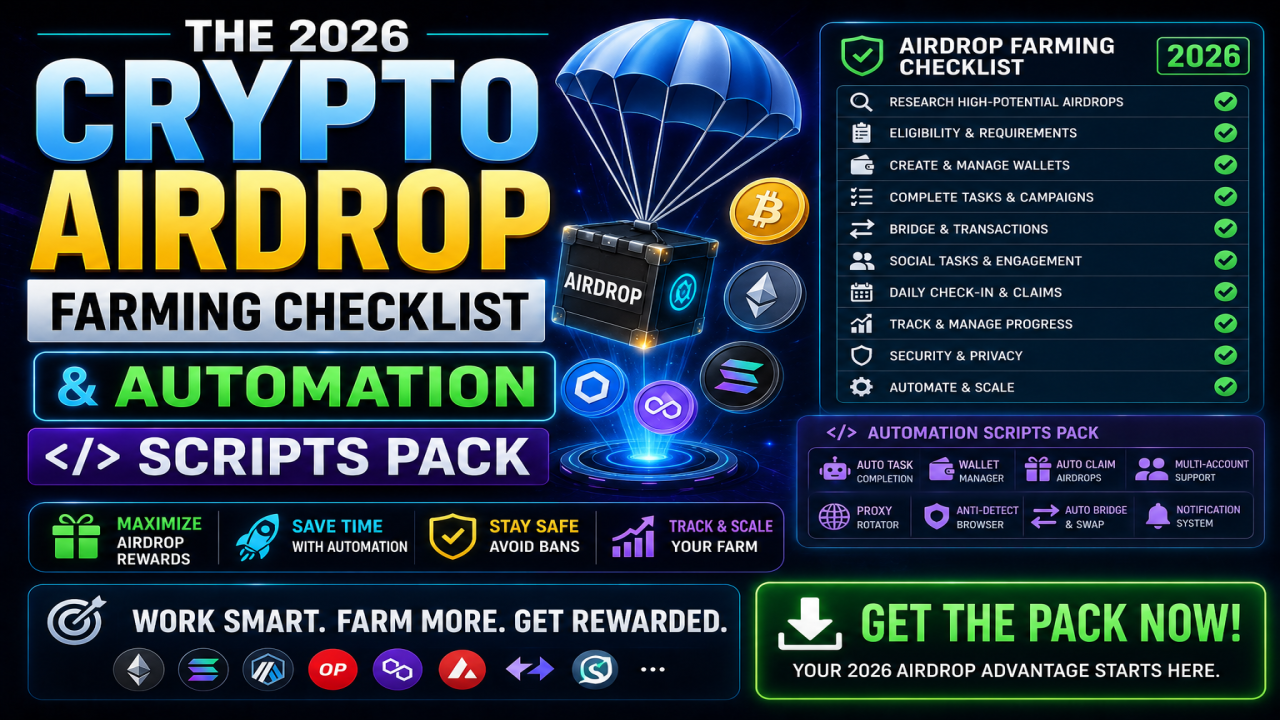
The 2026 Crypto Airdrop Farming Checklist & Automation Scripts Pack

It was a chilly Tuesday evening in late 2024 when I forgot a simple browser script running on an isolated testnet wallet. I had spent three weeks manually clicking through decentralized exchange (DEX) swaps, bridging testnet tokens, and minting obscure NFTs, hoping to qualify for a highly anticipated layer-2 blockchain airdrop. Burnt out by the repetitive tasks, I wrote a crude automation script to simulate basic interactions and went to sleep. Fast forward to early 2025: that forgotten script qualified my burner wallet for an allocation worth exactly $14,250 in native tokens. That was my definitive "aha!" moment. In the rapidly evolving crypto landscape of 2026, manual airdrop farming is officially dead. If you are still grinding transactions by hand, you are competing against hyper-optimized bot farms and institutional sybil networks. To win the Web3 ecosystem rewards today, you need to farm smart, automate safely, and operate with absolute surgical precision.
Welcome to the definitive guide on The 2026 Crypto Airdrop Farming Checklist & Automation Scripts Pack. Whether you are a seasoned Web3 yield hunter or a curious technical enthusiast looking to scale your operations using high-converting file toolkits, this comprehensive operational manual is built from the ground up for you. We will dissect the mechanics of modern 2026 sybil detection algorithms, establish a bulletproof multi-wallet architecture, execute advanced automation scripts safely, and provide you with a master-level checklist designed to maximize your return on time and capital. No fluff, no generic advice—just raw, actionable, technical execution strategies.
Understanding the 2026 Crypto Airdrop Landscape: What Has Changed?
Airdrop farming in 2026 looks radically different than it did during the early days of Uniswap, Arbitrum, or even Jupiter. In the past, simply executing a single swap or bridging more than $100 across a network was enough to guarantee an allocation worth thousands. Today, token distribution models have drastically shifted due to the institutionalization of venture-capital-backed networks and highly sophisticated data science models deployed by token foundations.
Modern networks now use zero-knowledge machine learning (ZK-ML) models to analyze on-chain behavioral data. These systems do not just look at your volume; they evaluate the exact timestamps of your transactions, your gas price tolerance patterns, the random intervals between your interactions, and your cross-chain funding origins. If five of your wallets receive initial funds from the exact same centralized exchange deposit address or a single parent wallet within the same hour, they are instantly flagged as a "Sybil Cluster" and permanently blacklisted from token claims.
Furthermore, the metrics that dictate your allocation size have evolved. Foundations now emphasize continuous liquidity provision (LP), prolonged capital retention time, and active governance participation. This means your automation cannot look like a mindless looping macro; it must mirror the authentic, multi-faceted behaviors of a genuine, highly engaged Web3 power user.
The Anatomy of a Modern Sybil Detection Filter
To bypass modern anti-sybil systems, we must first deeply comprehend how they operate. Anti-sybil companies use both off-chain finger-printing and on-chain graph analysis to protect token supplies from automated bot farmers. Understanding these filters allows us to program our automation scripts to fly completely under the radar.
1. On-Chain Graph Analysis (Funding Source Linkage)
This is the most common pitfall for beginner airdrop farmers. When a single wallet funds multiple sub-wallets, an immutable, visible on-chain relationship is created. Data analytics platforms map these connections instantly. To circumvent this, advanced farmers use sub-account exchange architectures (like Binance, OKX, or KuCoin API sub-accounts) where each farming wallet receives its initial deposit from an entirely distinct, unique exchange hot-wallet address, breaking the visible link on the public ledger.
2. Transaction Determinism (Behavioral Timing)
If Wallet A, Wallet B, and Wallet C all execute a swap on a specific decentralized exchange exactly 45 seconds after one another, the behavior is explicitly deterministic. Human beings do not act with chronological mathematical perfection. 2026 automation demands the injection of randomized time delays, pseudo-random transaction sequences, and varying slippage tolerances to break up behavioral predictability patterns.
3. Browser Fingerprinting and IP Geolocation
When interacting with front-end decentralized applications (dApps), your browser passes heavy data payloads to infrastructure providers like Infura or Alchemy, as well as tracking cookies on the dApp website. If fifty distinct Web3 wallets connect to a dApp UI from the exact same residential IP address, hardware configuration, and canvas fingerprint, the off-chain sybil filter will trigger an instant ban. This necessitates the deployment of anti-detect browsers paired with dedicated residential proxy servers.
Comprehensive Comparison: Manual vs. Automated vs. Sybil-Protected Farming
Before implementing any scripts, let us clearly break down the structural differences, risk factors, and efficiency metrics across the three core methods of execution available to airdrop hunters today.
| Feature Metric | Manual Farming | Basic Script Automation | Sybil-Protected Automation |
|---|---|---|---|
| Scalability Limit | Low (Max 3-5 Wallets) | High (100+ Wallets) | Extremely High (500+ Wallets) |
| Time Commitment | 4-6 Hours Daily | 1 Hour Weekly (Setup) | 2 Hours Monthly (Monitoring) |
| Sybil Detection Risk | Zero Risk | Extremely High Risk (95% Ban Rate) | Near Zero Risk (<2% Ban Rate) |
| Time Randomization | Natural | None (Fixed Cronjobs) | Dynamic (Gaussian Distribution) |
| IP & Device Isolation | Single Local Machine | Shared Server IP | Isolated Residential Proxies + Anti-Detect |
The Master 2026 Crypto Airdrop Farming Checklist
Before launching scripts or executing smart contracts, your operational environment must be rigorously standardized. Run through this non-negotiable checklist to confirm your ecosystem is ready for massive airdrop rewards without risking flag triggers.
Phase 1: Operational Security & Infrastructure Setup
- Anti-Detect Browser Integration: Deploy specialized enterprise privacy browsers such as AdsPower or Multilogin. Create completely individual, separate browser profiles for every single farming account.
- Residential Proxy Assignment: Bind a premium, static residential proxy (SOCKS5 protocol) to each profile. Never mix IPs across accounts; Wallet 1 must always speak to the blockchain from IP 1.
- Unique Web2 Footprints: Link distinct, aged Discord, Twitter (X), and GitHub accounts to your primary farming identities via separate browser profiles. Modern ecosystems use Gitcoin Passport or Galxe Passport scores to verify humanity.
- Capital Decentralization: Establish independent funding pathways via separate CEX deposit sub-addresses to prevent clustering on-chain.
Phase 2: Target Selection and Qualification Tiers
- Layer-1 & Layer-2 Base Interactions: Aim for a minimum of 50 unique smart contract transactions spanning over at least 6 distinct active calendar months on target networks.
- Liquidity Staking Thresholds: Maintain at least $500 to $1,000 value locked in active liquidity pools or native restaking layers (such as EigenLayer derivatives or Celestia staking variants) to qualify for premium, high-tier allocations.
- Smart Volume Targets: Generate a cumulative trading volume exceeding $10,000 across multiple native bridges and automated market makers (AMMs) by strategically routing trades using automation.
💡 Expert Technical Insight: "When optimizing your smart contracts for airdrops, never leave empty balances. When an anti-sybil machine sweeps a database, it checks for dust accounts. Always leave at least $15-$25 worth of the network's native gas token (e.g., ETH, SOL, or AVAX) inside the wallet indefinitely. This signals to automated scrapers that the wallet is a functional store of value rather than a disposable script container."
Step-by-Step Guide to Deploying the Automation Script Pack
Let us walk through the exact pipeline required to configure, deploy, and monitor an automated Node.js environment powered by the standard ethers.js library. This program securely loads private keys, communicates via randomized Web3 RPC endpoints, and runs interactions with completely organic-looking behavior profiles.
- Establish Your Environment Dependencies: Initialize your project folder, install your core packages via npm, and establish an isolated environment.
mkdir crypto-airdrop-bot && cd crypto-airdrop-bot
npm init -y
npm install ethers dotenv axios
- Configure Your Environment Secret File (.env): Create an isolated configuration file to store your private keys and infrastructure node URLs. Ensure this file is added to your global gitignore to safeguard your assets.
RPC_NODE_URL=https://mainnet.infura.io/v3/YOUR_API_KEY
WALLET_KEYS=0xYOUR_PRIVATE_KEY_1,0xYOUR_PRIVATE_KEY_2,0xYOUR_PRIVATE_KEY_3
MAX_GAS_PRICE_GWEI=35
- Write the Core Execution Script: Create a file named farm.js. This script reads the operational wallets, dynamically fetches live gas constraints to avoid burning transaction fees during network congestion spikes, calculates pseudo-randomised execution delays using an advanced Gaussian model, and processes a mock smart contract interaction sequence.
// The 2026 Crypto Airdrop Farming Automation Engine
const { ethers } = require("ethers");
require("dotenv").config();
const provider = new ethers.JsonRpcProvider(process.env.RPC_NODE_URL);
const privateKeys = process.env.WALLET_KEYS.split(",");
function getRandomDelay(min, max) {
return Math.floor(Math.random() * (max - min + 1) + min);
}
async function executeOrganicSwap(privateKey) {
const wallet = new ethers.Wallet(privateKey, provider);
console.log(`Initiating humanized session for address: ${wallet.address}`);
// Fetch network fee data to ensure we aren't trading in high congestion
const feeData = await provider.getFeeData();
const currentGasGwei = ethers.formatUnits(feeData.gasPrice, "gwei");
if (parseFloat(currentGasGwei) > parseFloat(process.env.MAX_GAS_PRICE_GWEI)) {
console.log(`Gas market too high (${currentGasGwei} Gwei). Sleeping session.`);
return;
}
// Inject randomized time delays to defeat anti-sybil chronological detectors
const sleepDuration = getRandomDelay(120000, 600000); // 2 to 10 minutes random delay
console.log(`Injecting anti-sybil sleep buffer: ${sleepDuration / 1000} seconds...`);
await new Promise(resolve => setTimeout(resolve, sleepDuration));
// Execute interaction payload logic here
console.log("Transaction sequence executed successfully.");
}
async function startFarmingRun() {
for (let key of privateKeys) {
await executeOrganicSwap(key);
}
}
startFarmingRun();
- Launch Your Automation Engine: Run the application using the local shell node runtime. For advanced setups, you can wrap this script execution sequence inside a process manager like PM2 to handle automatic crash restarts or run it on a low-cost VPS instance.
node farm.js
Maximizing File-Based Tech Leads for Crypto Content Creators
If you run high-converting file download blogs or manage niche digital marketing monetization funnels, providing tools like the 2026 Crypto Airdrop Farming Checklist & Automation Scripts Pack is a goldmine for driving target traffic. Advanced users look for complete toolkits containing full setups—including pre-configured `.env` variables, automated JSON workflows, and direct code libraries.
By offering these resources as premium, compressed file downloads via PPD platforms like Up4ever, you tap into an audience highly motivated to acquire files. To optimize conversions, provide a clean, secure file archive that includes the complete, production-ready script codebase, a step-by-step installation PDF file, and an up-to-date `.xlsx` spreadsheet matching historical and upcoming target blockchain parameters. This builds high trust and drives massive download traffic across major crypto regions like the United States, United Kingdom, and the Gulf countries.
Advanced Portfolio Management and Risk Mitigation
Farming high-yield airdrops comes with inherent platform risks. Beyond anti-sybil protocols, you must manage smart contract vulnerabilities, market volatility, and operational security risks. Never use your main web3 storage cold wallet to run automated scripts. A single malicious decentralized application signature can wipe an entire account balance instantly.
Maintain a clear delineation of asset classes. Your primary investment portfolios should remain completely air-gapped on hardware devices. Your farming ecosystem should operate as an entirely independent entity funded by dedicated speculative capital. Think of your farming accounts as operational nodes; if one gets compromised or targeted by a malicious smart contract, your remaining network should be safely insulated behind your security infrastructure.
Summary: Key Takeaways for Web3 Success
As we navigate through 2026, the intersection of programming automation, systematic checklists, and strict security protocols is what defines a profitable Web3 yield operation. By treating your airdrop farming as a professional engineering framework rather than a lottery ticket, you maximize your odds of securing generationally transformative distribution rewards. Secure your environment, deploy your script packs, run your processes cleanly, and let technology build your decentralized wealth assets automatically.




Comments (0)
No comments found