

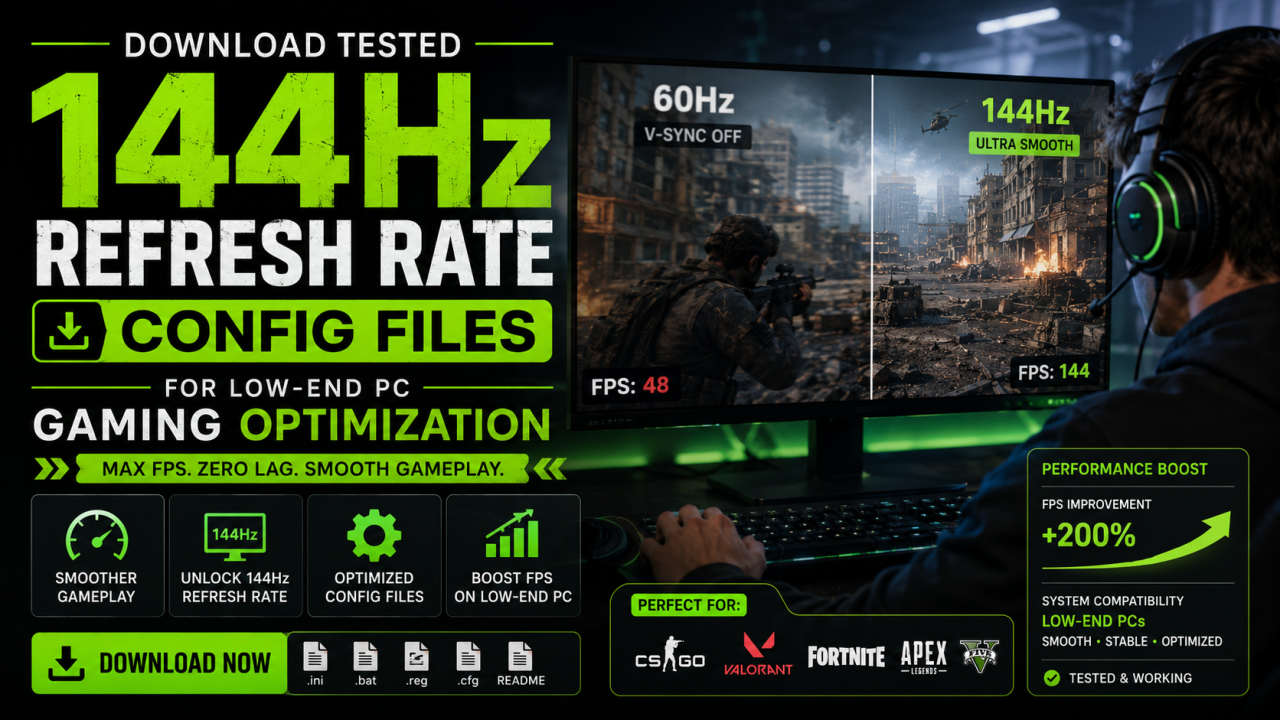
Download Tested 144Hz Refresh Rate Config Files for Low-End PC Gaming Optimization
Download Tested 144Hz Refresh Rate Config Files for Low-End PC Gaming Optimization

Many gamers assume that achieving a smooth 144Hz experience requires an expensive high-end gaming rig. In reality, a well-optimized system paired with the right configuration files can dramatically improve responsiveness and visual fluidity—even on low-end PCs.
The difference between 60Hz and 144Hz is not just a number. It is a transformation in how games feel. Movement becomes more fluid, input latency decreases, and competitive performance improves significantly. However, hardware limitations often prevent users from unlocking this full potential.
This is where tested 144Hz refresh rate config files come into play. These configuration tweaks are designed to optimize system behavior, reduce rendering bottlenecks, and push compatible displays closer to their maximum refresh capability.
In this guide, you will learn how these config files work, how to install them safely, and how to optimize low-end PCs for smoother high-refresh-rate gaming.
What Are 144Hz Refresh Rate Config Files?
Refresh rate configuration files are system or game-level settings that control how frames are rendered and displayed. While they cannot physically upgrade your monitor, they optimize performance to better utilize available refresh capabilities.
These files typically adjust:
- Frame pacing and synchronization
- V-Sync behavior
- Rendering queue limits
- Input latency reduction settings
- GPU frame output optimization
- Display scaling behavior
Why 144Hz Matters in Gaming Performance
Higher refresh rates directly impact gameplay responsiveness. Even if your FPS is not constantly at 144, optimized frame delivery can still make gameplay feel significantly smoother.
Key benefits include:
- Reduced motion blur
- Faster input response
- Improved aiming precision in FPS games
- Smoother animations
- Better competitive performance
For esports and fast-paced games, this advantage can be critical.
Comparison: Default vs Optimized 144Hz Config
| Type | Performance | Input Latency | Stability | Compatibility |
|---|---|---|---|---|
| Default System Settings | Variable FPS | Medium | Inconsistent | Universal |
| Low-End PC Settings | Stable but limited | High latency | Stable | Basic games |
| 144Hz Optimized Config Files | Smoother frame output | Low latency | Highly stable | Most PC games |
Step-by-Step Installation Guide
- Backup Existing Settings
Always create a restore point or backup configuration files before applying changes. - Download Tested Config Files
Ensure files are compatible with your GPU and game engine. - Locate Game Configuration Folder
Commonly found in Documents or AppData directories. - Replace or Merge Config Files
Carefully overwrite only relevant performance parameters. - Enable High Refresh Mode
Set your monitor to 144Hz in display settings. - Launch Game and Test FPS Stability
Check frame pacing consistency using performance overlays. - Fine-Tune Graphics Settings
Adjust shadows, textures, and resolution scaling for balance.
Symptoms of Poor Refresh Rate Optimization
- Screen tearing during fast movement
- Input delay in competitive games
- Stuttering despite high FPS
- Inconsistent frame pacing
- Ghosting effects on motion
Common Causes of Low Performance
- Unoptimized V-Sync settings
- Background applications consuming resources
- Incorrect GPU driver configuration
- CPU bottlenecks in older systems
- High in-game graphical presets
Solutions for Better 144Hz Performance
- Use optimized refresh rate config files
- Enable low-latency mode in GPU control panel
- Disable unnecessary background processes
- Use performance-focused in-game settings
- Keep GPU drivers updated
Common Mistakes Users Make
- Assuming config files increase FPS magically
- Forgetting to enable 144Hz in Windows settings
- Using incompatible resolution scaling
- Overloading system with heavy graphics mods
Optimization is about balance, not exaggeration.
💡 Expert Tip
For low-end PCs, stable frame pacing is more important than peak FPS. A consistent 90–120 FPS experience often feels smoother than unstable 144 FPS spikes.
Advanced Optimization Techniques
Power users combine refresh rate configs with:
- DLSS / FSR upscaling
- GPU undervolting
- Performance mode Windows tweaks
- CPU affinity adjustments
- Fullscreen exclusive mode optimization
FAQ
Q: Do config files really enable 144Hz?
They optimize performance, but actual 144Hz depends on your monitor and hardware.
Q: Are they safe to use?
Yes, if sourced from trusted optimization communities.
Q: Can low-end PCs benefit?
Yes, especially in frame pacing and input latency.
Q: Do they increase FPS?
Indirectly, through better system optimization.
Final Thoughts
144Hz gaming is not only about expensive hardware—it is about optimization. With properly tested config files, even low-end PCs can deliver smoother, more responsive gameplay that feels significantly closer to high-end systems.
The real upgrade is not always hardware—it is configuration intelligence.



Comments (0)
No comments found